
Medically reviewed by: Dr. Samiha Ghoghari M.D.(Hom.)
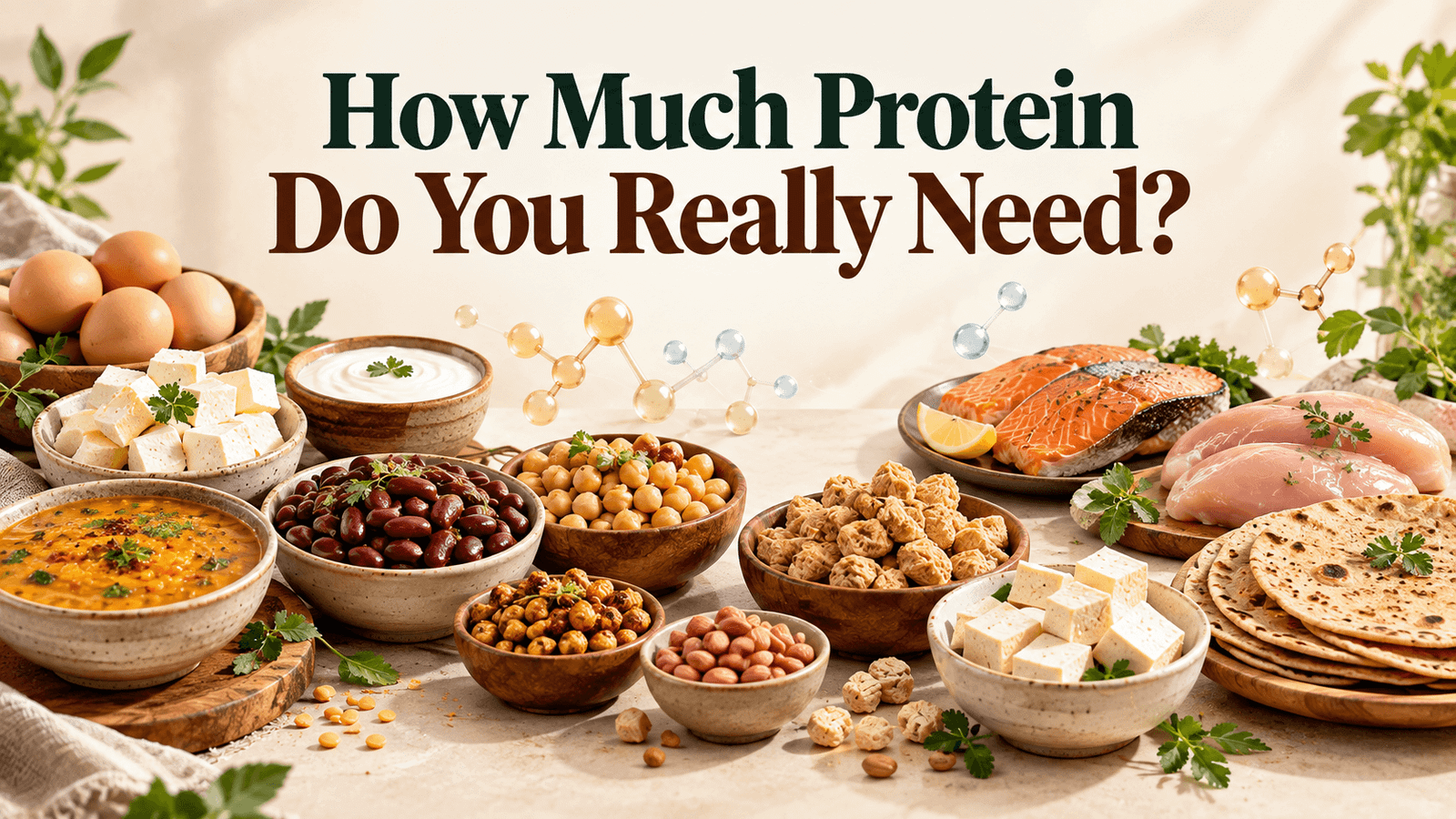
Protein requirement for Indians is a topic that gets more confusing every year, with protein bars, shakes and “high-protein” labels now on almost every shelf. Are you really falling short, or is this just clever marketing? It is a fair question. Much of what circulates about protein, such as “eat every three hours” or “the body cannot absorb more than 30 g at a time”, is not supported by strong evidence.
This guide explains what protein does, how much you actually need according to Indian guidelines, what low intake looks like, and how to fix it using everyday foods from your own kitchen.
What Is Protein and Why Does Your Body Need It?
Protein is one of the three macronutrients, along with carbohydrates and fat. It is made of chains of amino acids, which the body uses to repair tissues, build new cells and make enzymes and hormones. It is especially important for growth in children and teenagers, and during pregnancy and breastfeeding.
Amino acids are of three kinds. Essential ones must come from food, non-essential ones are made by the body, and conditional ones become important during illness or physical stress. You do not need every essential amino acid at every meal. What matters is the balance across the day.
You also do not need meat to get all of them. Milk, curd, paneer and eggs provide complete protein, and so do soya, dals, rajma, chana, peanuts and grains when eaten in sensible combinations. A well-planned vegetarian Indian diet can meet the full requirement.
How Much Protein Do Indians Actually Need?
There are two different numbers, and the gap between them causes most of the confusion.
The Official Minimum
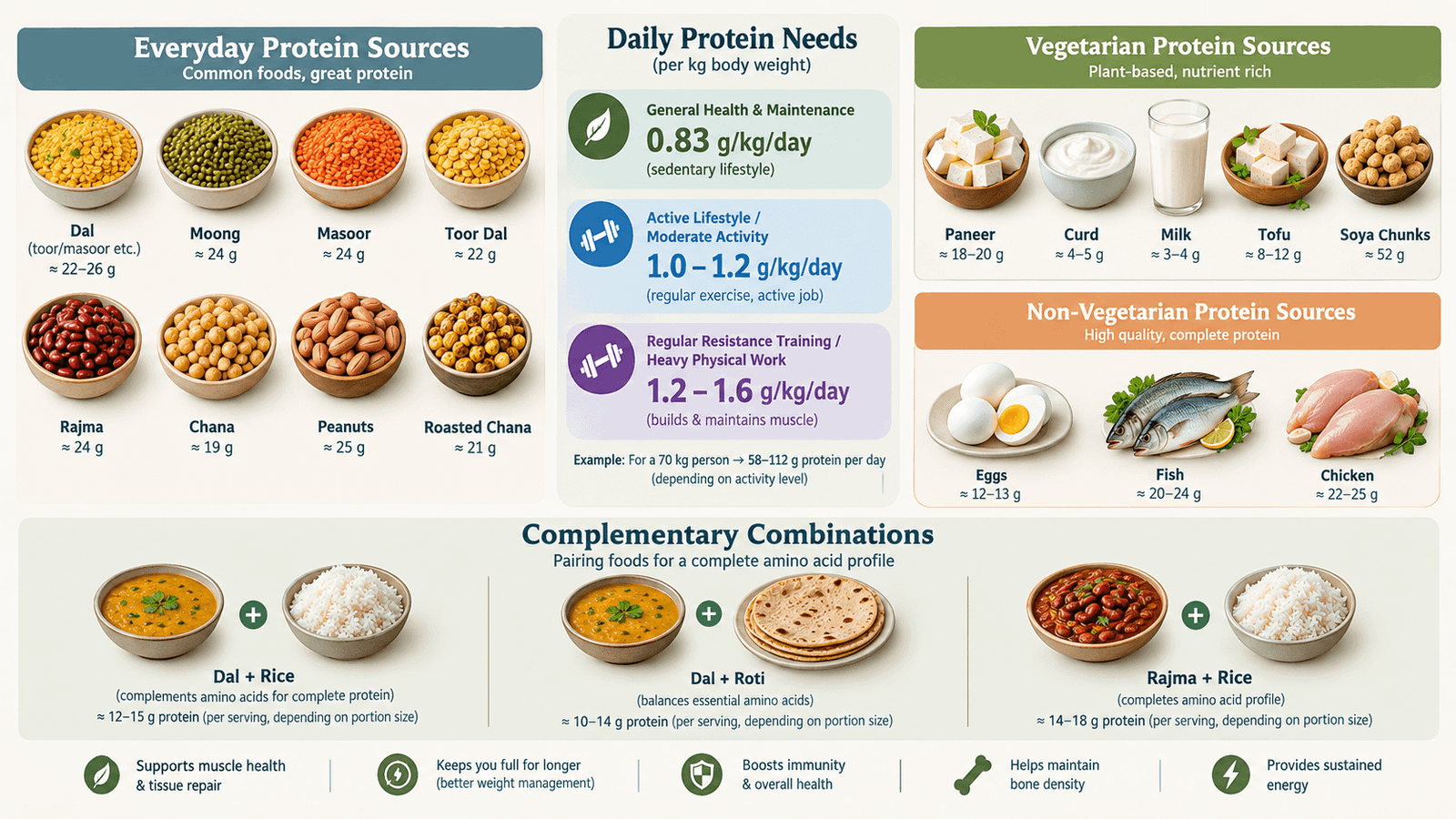
The ICMR-NIN Expert Group (2020) sets the Recommended Dietary Allowance (RDA) for healthy Indian adults at 0.83 g of protein per kg of body weight per day. This works out to about 54 g a day for a reference man weighing 65 kg and 46 g for a reference woman weighing 55 kg.
The RDA is the amount that keeps nearly every healthy person from becoming deficient. It is a safety floor and not necessarily the level for the best muscle or metabolic health.
The More Practical Target
Many researchers now suggest that 1.0 to 1.2 g/kg/day supports better lean mass and metabolic function in most adults. People who do regular resistance training or heavy physical work often do well on 1.2 to 1.6 g/kg/day. For a 65 kg adult, that means roughly 65 to 78 g a day for general health, and more for someone strength training.
To picture this, two eggs, a katori of dal, a bowl of curd, a serving of chana or rajma, and a few rotis together provide a large part of that figure, spread across the day.
Why Many Indian Diets Fall Short
Traditional Indian meals are often built around rice or wheat, with small portions of dal and vegetables. Cereals do contain protein, but they are low in an amino acid called lysine. Dals and legumes are rich in lysine but low in methionine, so eating them together fills each other’s gaps. This is why the classic pairings of dal-chawal, roti with dal, and rajma-rice work so well nutritionally.
The problem arises when the dal portion is small, skipped, or replaced by refined snacks. Cost, busy schedules and the habit of a light breakfast, such as tea and biscuits, also push protein intake down, particularly for people who eat little or no meat, egg or dairy.
Signs of Low Protein Intake
A mild, early shortfall tends to show up in ordinary ways rather than anything dramatic. The most common signs are persistent tiredness and weakness, hair thinning or increased hair fall, brittle nails, and cuts or wounds that heal more slowly than usual. Some people fall ill more often, or notice a drop in muscle mass and strength. Swelling of the feet, legs or abdomen (oedema) can appear when intake has been very low for a long time.
One symptom on its own means very little. Fatigue and hair fall overlap with many other causes, including poor sleep, thyroid problems, iron deficiency, vitamin B12 or vitamin D deficiency, and stress. It is the pattern of several signs together, alongside a diet that is genuinely low in protein-rich foods, that deserves attention.
At the severe end, a prolonged and significant shortage of protein and energy can cause protein-energy malnutrition, seen as marasmus or kwashiorkor. This is most often seen in young children in resource-limited settings and is very unlikely in an adult eating a reasonably adequate diet.
Who Is at Higher Risk?
True deficiency is uncommon in people with access to a varied diet, but some groups are more vulnerable. Older adults often eat less and absorb protein less efficiently. People recovering from surgery, illness or burns need more. Those on very restrictive or crash diets, or with very low calorie intake, can fall short. Conditions that affect digestion or absorption, such as coeliac disease or inflammatory bowel disease, also raise the risk, as does loss of protein through liver or kidney disease.
Pregnant and breastfeeding women have higher needs as well. ICMR-NIN recommends additional protein during the second and third trimesters and while breastfeeding.
How Is Low Protein Intake Diagnosed?
There is no single home test. A doctor usually looks at the whole picture, starting with a detailed diet history of what you actually eat over several days, not what you assume you eat. Blood tests such as total protein and albumin may be advised, though these can also change with liver disease, inflammation or hydration, so they are not conclusive on their own. Examination for muscle wasting, skin or hair changes and swelling adds to the picture, and grip strength or body composition checks may be used to assess muscle directly.
A single low lab value does not confirm a deficiency. It must be read together with your symptoms and diet.
Best Indian Sources of Protein
You do not need imported or expensive products to meet your needs. Everyday foods do the job well.
Vegetarian Sources
Dals such as moong, masoor, toor and urad, along with chana, rajma, chole, lobia and sprouts, are the backbone of Indian protein intake and are also affordable. Paneer, curd, chaas and milk add complete protein and calcium. Soya chunks and tofu are among the most protein-dense vegetarian options, while peanuts, roasted chana, seeds and nut butters make useful snacks. Whole grains such as wheat, bajra, jowar and ragi add smaller but meaningful amounts.
Non-Vegetarian Sources
Eggs are one of the most affordable complete proteins available. Chicken, fish and lean mutton add high-quality protein along with iron and vitamin B12, which many vegetarians struggle to get in sufficient amounts.
Simple Ways to Improve Your Protein Intake
For most people, no overhaul is needed. What helps is including protein consistently.
Add protein at every meal. Instead of tea and biscuits for breakfast, choose eggs, besan chilla, moong dal cheela, sprouts, curd or paneer paratha. Lunch and dinner can each include a generous katori of dal, legumes, fish, chicken or paneer.
Pair your cereals and pulses. Dal with rice or roti, khichdi, and rajma-chawal give a more complete amino acid profile than either food alone.
Choose protein-rich snacks. Roasted chana, a handful of peanuts, a glass of chaas or a bowl of curd work better than fried or sugary snacks.
Do not overcorrect. More is not automatically better. Sustained intakes well above 2 g/kg/day show no clear extra benefit for most people and may not suit anyone with kidney disease. ICMR-NIN’s dietary guidelines also advise a food-first approach and caution against relying on protein powders and supplements, which often contain added sugars and additives.
Pair protein with movement. Protein alone does not build or preserve muscle. Resistance exercise, or even regular brisk walking and bodyweight work, tells the body to use it.
When Should You See a Doctor?
Occasional tiredness or mild hair fall is usually not a cause for alarm. Do get checked if you notice ongoing, unexplained loss of muscle or strength, swelling in the legs or abdomen that does not settle, wounds that heal unusually slowly, unintentional weight loss with a very restricted diet, or an elderly family member who is eating noticeably less than before.
A doctor can rule out other causes such as thyroid problems, anaemia or vitamin deficiencies, and check whether protein intake or something else is behind your symptoms.
Frequently Asked Questions
How much protein does an Indian adult need per day?
As per ICMR-NIN (2020), the RDA is 0.83 g/kg of body weight for healthy adults, about 54 g for men and 46 g for women at reference weights. Many people benefit from 1.0 to 1.2 g/kg, and those training regularly may need up to 1.6 g/kg.
Can I get enough protein on a vegetarian diet?
Yes. Combining dals, legumes, grains, curd, paneer, soya and nuts through the day covers the full amino acid requirement.
Is dal-chawal enough protein?
It contributes well, and the combination gives a good amino acid balance. However, the portion of dal matters, so add curd, eggs, paneer, sprouts or other sources across the day to reach your target.
What are the first signs of low protein intake?
Tiredness, hair or nail changes and slower healing of minor cuts are usually the earliest and most subtle signs. Because they overlap with other conditions, do not self-diagnose.
Is too much protein harmful?
In people with healthy kidneys, no clear harm has been shown at the intakes seen in most high-protein diets. People with kidney or liver disease should follow their doctor’s advice.
Do I need protein powder or supplements?
Most people can meet their needs through regular food. Supplements are a matter of convenience, not necessity.
Bottom Line
Protein is nothing to obsess over, but it is not something to leave to chance either. Most people eating a varied diet get enough, but if you are elderly, very active, recovering from illness, pregnant, or eating a restricted or largely cereal-based diet, it helps to add up what you eat over a few days. Build each meal around a dal, legume, egg, dairy or lean meat, and treat supplements as optional. If you notice persistent fatigue, unexplained muscle loss or slow healing, speak to a doctor instead of guessing with powders.
Medical Disclaimer: This article is for general educational purposes and is not a substitute for professional medical advice, diagnosis or treatment. If you have persistent or concerning symptoms, please consult a qualified healthcare professional.
References
- ICMR-NIN Expert Group. Nutrient Requirements for Indians: Recommended Dietary Allowances (RDA) and Estimated Average Requirements (EAR) – 2020. ICMR-National Institute of Nutrition, Hyderabad. Available from: https://www.nin.res.in/rdabook/brief_note.pdf
- Indian Council of Medical Research, National Institute of Nutrition. Dietary Guidelines for Indians. Hyderabad; 2024.
- National Academy of Sciences, Institute of Medicine, Food and Nutrition Board. Dietary reference intakes for energy, carbohydrate, fiber, fat, fatty acids, cholesterol, protein, and amino acids. J Am Diet Assoc. 2002;102(11):1621-1630. Available from: https://pubmed.ncbi.nlm.nih.gov/12449285/
- Joint FAO/WHO/UNU Expert Consultation. Protein and amino acid requirements in human nutrition. WHO Technical Report Series 935. Geneva: WHO; 2007. Available from: https://iris.who.int/handle/10665/43411
- National Library of Medicine, MedlinePlus. Protein in diet. Available from: https://medlineplus.gov/ency/article/002467.htm
- Benjamin O, Lappin SL. Kwashiorkor. In: StatPearls [Internet]. Treasure Island (FL): StatPearls Publishing. Available from: https://www.ncbi.nlm.nih.gov/books/NBK507876/